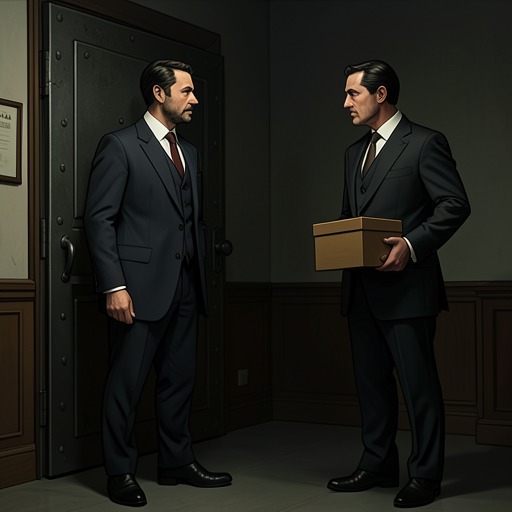
Kurt Barlow and Richard Straker
'Salem's Lot: A NovelKurt Barlow and Richard Straker form the central partnership through which the supernatural takeover of Jerusalem’s Lot acquires a respectable public face. Presented as antiquarian businessmen and longtime associates, they arrive with an apparently ordinary commercial plan; beneath that plan, however, Barlow is the commanding power and Straker the disciplined servant who prepares the ground, manages the public world, and accepts the prospect of sacrifice as the price of loyalty.
Public Partnership and Arrival
Richard Straker introduces himself to Parkins Gillespie as the partner of Kurt Barlow, presenting their new establishment as a modest retirement venture devoted to old and fine things. He explains that the two men have worked together in London and Hamburg and that their shop is intended to earn a living and build a reputation across New England. The language is courteous and commercial, but the encounter also establishes the division of labor between them: Straker deals with the public while Barlow remains absent, supposedly in New York on a buying trip.
That absence is part of the partnership’s operational design. Straker opens the store without Barlow and receives the curious townspeople himself, while Barlow’s name circulates as the unseen other half of the enterprise. Straker’s striking appearance—he is totally bald, extremely graceful, elegantly dressed, and charming—helps make the shop memorable. His manner is controlled enough to reassure visitors, yet his dry, unusually strong handshake and the unpleasant smell beneath the fresh paint give the apparently tasteful business an undertone that ordinary commerce cannot explain.
History, Division of Labor, and Secrecy
The partnership predates the arrival in Jerusalem’s Lot by decades. Barlow is British by naturalization, born in Germany and taken to England in 1938, and has worked in London’s import-export trade since 1945. Straker, British by birth and fifty-eight years old, comes from a cabinetmaking family in Manchester and has inherited money from his father. Official inquiries find Straker easier to place than Barlow, whose earlier records are unavailable and whose original name was Breichen. The contrast makes Barlow elusive while leaving Straker as the identifiable intermediary.
Their long association is therefore both practical and asymmetrical. The available account describes Straker as the man who deals with the public, while Barlow remains difficult to trace and protected by the partner who supplies explanations on his behalf. Even the pair’s move to the United States is framed through paperwork and business arrangements: both applied for visas to spend an extended period there eighteen months before the investigation. The partnership’s respectability depends on ordinary documents, a shop, and Straker’s conversational skill, while its deeper purpose depends on withholding the truth about Barlow.
Service, Authority, and the Hidden Hierarchy
The relationship becomes unmistakably hierarchical when Straker meets Barlow outside town near the end of the original ending to Susan. The scene places them in the wild country along Deep Cut Road, near the landscape devastated and reshaped by the 1951 fire. Straker waits beside a black Packard while a shifting darkness takes form beside him; the visual merging of the two shadows makes their partnership appear almost physically fused, but their speech reveals that they are not equals.
Straker reports on the condition of Barlow’s opponents. Ben Mears is in the hospital, Floyd Tibbits is in the constable’s lock-up, and Matt Burke is also hospitalized after a heart attack. When Straker asks whether Master Glick is carrying out his work, Barlow answers that he is. The exchange is less a business conference than a servant’s briefing to a superior: Straker monitors the human obstacles, Barlow evaluates the progress of the larger operation, and the vampire hierarchy remains the unquestioned center of their activity.
Straker’s most revealing question is whether his time has come. Barlow replies that it is almost time, and Straker answers with the repeated declaration that their father has been kind. The words combine devotion with resignation. Straker knows that service may end in his own destruction or transformation, yet he does not challenge the arrangement. His loyalty is not merely professional; it is a submission to the authority represented by Barlow and by the paternal language of the dark master they both acknowledge.
Collapse and Narrative Significance
The partnership also explains how the threat is distributed across the plot. Straker’s public presence makes Barlow’s arrival appear to be the opening of an antique shop, while his hidden obedience makes the shop and the Marsten House instruments of a much larger invasion. When Ben Mears considers meeting Straker, he worries that Straker might prove to be an ordinary businessman and disrupt the book he is writing about the Marsten House. That fear captures the partnership’s narrative function: Straker stands at the border between mundane explanation and supernatural truth.
The partnership finally becomes vulnerable when the servant is removed. Barlow later declares that Mark Petrie has robbed him of the most faithful and resourceful servant he has ever known, a furious acknowledgment that Straker was not an expendable shopkeeper but the indispensable agent of the operation. Barlow’s threat against Mark’s parents and then Mark himself is driven by that loss. The partnership’s end therefore changes the balance of the conflict: Barlow remains dangerous, but the public organizer who enabled his plans has been taken away, and the master’s rage exposes both his dependence on Straker and the limits of his control.
Through Barlow and Straker, the novel turns partnership into a structure of concealment and power. Their polished commercial identity rests on shared history, mobility, and carefully managed appearances; their actual bond is defined by command, service, secrecy, and anticipated sacrifice. Straker’s graceful public performance permits Barlow to remain hidden, while Barlow’s supernatural authority gives Straker’s ordinary-looking work its terrible purpose. The relationship is thus not a balanced alliance but a long-term hierarchy disguised as business partnership.